 While it is widely understood that community and and school gardening have innumerable health, well-being and educational benefits, it’s important to realize these benefits don’t magically appear when gardens take root.
Over the past six years, I’ve worked closely with educators, community workers, activists and community members in Tio’tia:ke/Montréal as we created, funded and sustained gardens and garden teams at schools and community organizations.
We set up adult education internships to provide practical gardening and teaching support to explore the extent to which gardens act as forums where people address social and environmental justice. Some participants experienced barriers to employment, food insecurity and homelessness.
This research and community work demonstrated how critical it is to advocate for broader social, urban and educational structural changes to support community garden work — and to understand the importance of having realistic expectations about what people can accomplish in and through gardens.
While it is widely understood that community and and school gardening have innumerable health, well-being and educational benefits, it’s important to realize these benefits don’t magically appear when gardens take root.
Over the past six years, I’ve worked closely with educators, community workers, activists and community members in Tio’tia:ke/Montréal as we created, funded and sustained gardens and garden teams at schools and community organizations.
We set up adult education internships to provide practical gardening and teaching support to explore the extent to which gardens act as forums where people address social and environmental justice. Some participants experienced barriers to employment, food insecurity and homelessness.
This research and community work demonstrated how critical it is to advocate for broader social, urban and educational structural changes to support community garden work — and to understand the importance of having realistic expectations about what people can accomplish in and through gardens.
Who do benefits reach?
In Tio’tia:ke/Montréal, community gardening unfolds in many different ways that might include gardening efforts at community-based organizations and city-run gardens. There are significant wait lists to access a garden plot in the city, exacerbated by community gardens being historically reserved for property-owning individuals. According to the mayor of Montréal, “for many people, community gardens are more than just a hobby. They allow them to feed their families and to obtain fresh produce at a low cost.” Such statements obscure more complex issues around who controls and accesses community gardens and deeper entrenched social inequities relating to land rights in a capitalist settler-colonial society that privileges ownership, whiteness and hierarchical modes of relating.Relationship to food insecurity
My findings contest claims that suggest community gardening is inherently an activity that reduces under-served communities’ food insecurity. Reflecting on my efforts to grow food for organizations that work with people experiencing food insecurity, as part of a project called “Gardening for Food Security,” I cannot claim gardening helped to alleviate the concerns of people experiencing food insecurity in any quantifiable way. This is despite producing an immense amount of food harvested on a weekly/bi-weekly basis from late June to early November in 2018 and 2019. Although the gardens were thriving, the organization never reduced their food order to Montréal’s largest food bank. This may be because while participants ate from the garden harvest, their reliance upon it did not reduce their need for other food. The Gardening for Food Security project did, however, modestly support a food bank and a once-a-week meal service.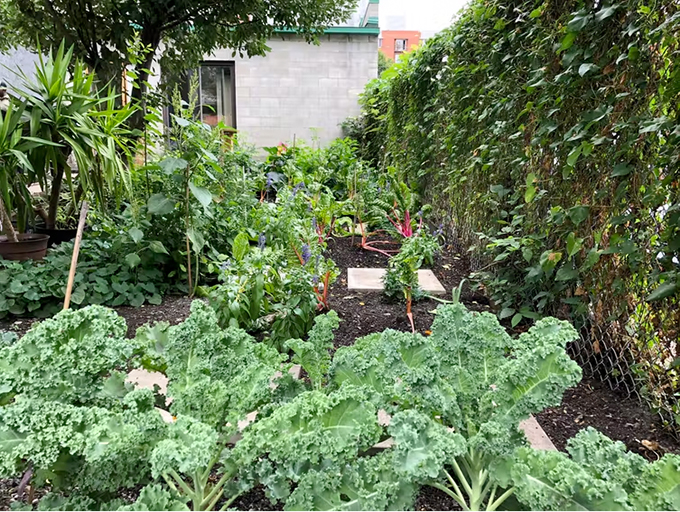
Kale seen growing in the garden of Benedict Labre House, an organization serving people experiencing homelessness, in the Griffintown, Montréal. (Mitchell McLarnon), Author provided (no reuse)
Mixed effects for communities, individuals
As we gardened and invested in gardens for different social, educational and environmental reasons in rapidly gentrifying neighbourhoods, we contributed to increasing land values in a process described as green gentrification. Despite these critical observations, some benefits of the project included:- offering relevant paid employment for young adults experiencing barriers to employment, food insecurity and homelessness;
- providing mentorship and opportunities for under-served young adults and students to express themselves (through art, photography, music, film, gardening);
- facilitating partnerships between schools and organizations with mandates of social and environmental justice for mutual benefit;
- acquiring prolonged financial, learning and human resource support to educators, learners, community workers and community members, while developing ethical relationships and collaborating to accomplish shared objectives.
