 The Australian Defence Force (ADF) is about to get a lot bigger. Defence Minister Peter Dutton has announced plans to expand the ADF by 18,000 members by 2040. This nearly 30% increase, the largest since the Vietnam War, will require not only a renewed focus on recruitment, but also on retaining current sailors, soldiers and aviators.
Families of these uniformed personnel will be crucial to the success of these efforts. The families of defence personnel, especially those with children, experience significant impacts as a result of their service. Our research has highlighted the experiences of young children and the pressures on defence families.
The increase in ADF personnel will require a major rethink of policies and procedures to protect the well-being and education of children in defence families. The ADF needs to become an employer of choice to retain these families as well as attract recruits with families. Our research findings offer some ideas that could inform the policy changes needed to achieve this boost to defence numbers.
The Australian Defence Force (ADF) is about to get a lot bigger. Defence Minister Peter Dutton has announced plans to expand the ADF by 18,000 members by 2040. This nearly 30% increase, the largest since the Vietnam War, will require not only a renewed focus on recruitment, but also on retaining current sailors, soldiers and aviators.
Families of these uniformed personnel will be crucial to the success of these efforts. The families of defence personnel, especially those with children, experience significant impacts as a result of their service. Our research has highlighted the experiences of young children and the pressures on defence families.
The increase in ADF personnel will require a major rethink of policies and procedures to protect the well-being and education of children in defence families. The ADF needs to become an employer of choice to retain these families as well as attract recruits with families. Our research findings offer some ideas that could inform the policy changes needed to achieve this boost to defence numbers.
Slaves to two greedy masters
Recruitment is challenging because the military is a “greedy institution” demanding great sacrifice from personnel and their families. Likewise, families are also “greedy institutions”, demanding enormous sacrifices from parents. Defence families’ efforts to satisfy each master are doomed from the start and many personnel list “family reasons” when they leave. Dutton acknowledged these issues last week: “[W]e lose people at way too young an age after we’ve invested an enormous amount in them. I am very conscious of people being posted for two years, and their children being dragged from school to school. I’m conscious of the impact on predominantly mothers, wives, in that arrangement […]”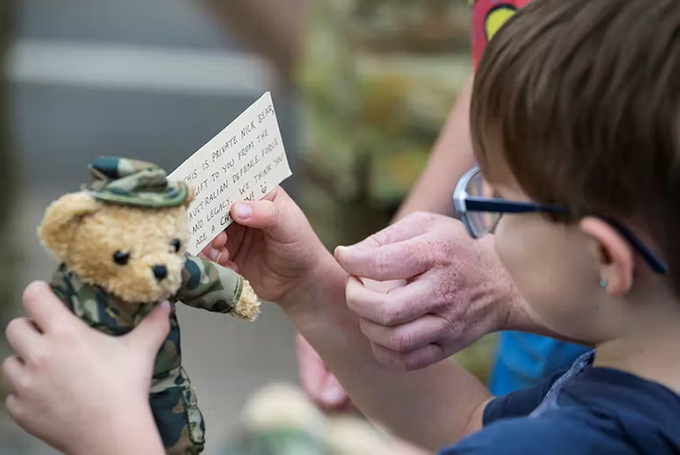
An Omeo boy reads the card attached to a Legacy bear presented to him by staff of the Latchford Barracks Relief Centre on January 21 2020. Department of Defence/Commonwealth of Australia
The kids are not alright
Key aspects of military life, like deployments and relocations, have a big impact on children. It can seem like children’s well-being, education and special needs are sacrificed to ADF members’ career needs. This includes compromising secure relationships with their early childhood educators and peers. The impacts on children’s learning are severe because quality early education relies on interactions within secure relationships with educators. Young children can struggle to understand the changes at home when they relocate, or a parent goes away on deployment or extended training. The trouble children have in understanding the demands of military service is clear in this exchange between two-year-old Emily, one of our research participants, and her mother: “But where’s Dad?” “Daddy’s gone on the plane, darling. Remember, we took Dad to the airport yesterday.” (Emily starts crying and throws herself on the ground.) While deployment is challenging, reintegrating defence parents back into the family can be harder. In the same study, one mother said her coping strategy was to have a very relaxed style of parenting when her partner deployed. They ate when they were hungry and her son went to bed in front of the TV. “I go to pieces in the last month again. We have to sort of prepare for him coming home. […] Paul is like a military man. You know, routines. There are mealtimes, he says what we are watching when the TV is on. […] There are bedtimes. So I say to Jack, ‘You know what we do now is just our thing. When Daddy gets home we have to do it his way.’ ”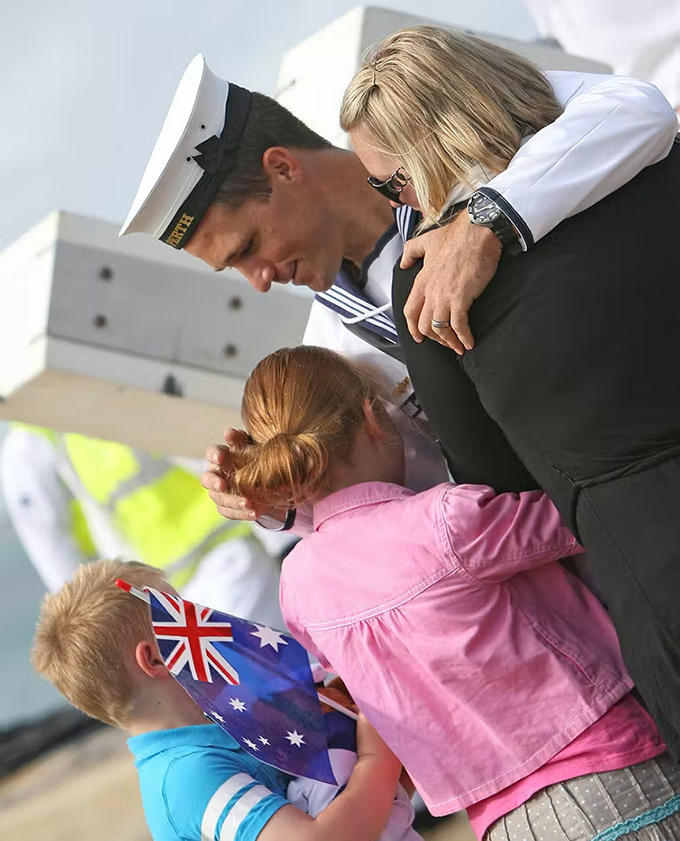
A sailor hugs family members after his deployment ends. Department of Defence/Commonwealth of Australia
