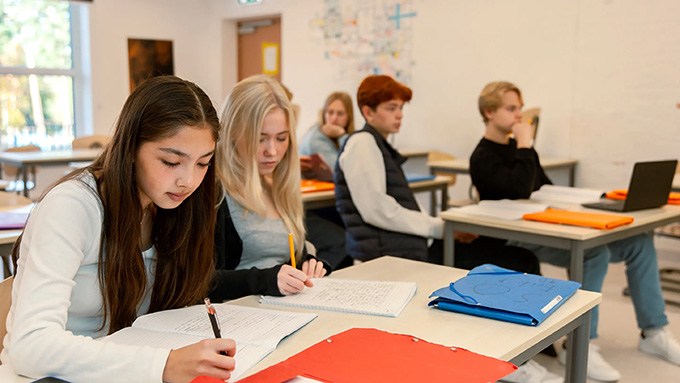
 When we’re in a classroom, at a conference, watching a video, or listening to a podcast, and we want to increase the likelihood of remembering its content in the future, the best strategy we can follow is note-taking.
Organizing and taking notes is key to improving comprehension, attention , and long-term learning . Some people just listen or doodle, either out of boredom or because they fall into the so-called learning illusion, which leads them to believe they’ll easily remember the content.
However, listening to a lecture without taking notes is like trying to catch water with your hands: you’ll retain some of it in the moment, but most of it will slip away before you can use it. In both cases, the lack of active processing leads to greater mental distraction and poorer information retention.
When we’re in a classroom, at a conference, watching a video, or listening to a podcast, and we want to increase the likelihood of remembering its content in the future, the best strategy we can follow is note-taking.
Organizing and taking notes is key to improving comprehension, attention , and long-term learning . Some people just listen or doodle, either out of boredom or because they fall into the so-called learning illusion, which leads them to believe they’ll easily remember the content.
However, listening to a lecture without taking notes is like trying to catch water with your hands: you’ll retain some of it in the moment, but most of it will slip away before you can use it. In both cases, the lack of active processing leads to greater mental distraction and poorer information retention.
The great effects of note-taking
There are two main effects of note taking:- Encoding effect: Note-takers actively process information, which promotes deeper processing and improves information retention.
- External storage effect: Notes serve as a review resource, facilitating the consolidation of learning.
Strategies to improve learning
There are several strategies for taking notes :- Words only: Notes in the form of single words, phrases, or unorganized paragraphs.
- List: Information organized in sequence with bullets or numbering.
- Hierarchical structure: vertical and horizontal structure with main ideas and secondary details.
- Concept map: graphic representation with shapes, lines and connections between concepts.
- Drawing: illustrations, diagrams or schemes.
Paper or digital?
For years , it has been argued that taking notes by hand facilitates deeper information processing and improves long-term retention. However, more recent studies challenge this idea, pointing out that, with the right strategies, tablets and computers can be just as effective. Furthermore, current technology allows us to take notes “by hand” using electronic pens. Traditional studies compared typing on a computer with writing on paper, but today digital options have evolved, allowing us to combine the best of both worlds. Digital knowledge managers , like Obsidian , allow us to access our notes from anywhere in a matter of seconds. They also facilitate the connection between different notes, which enhances the integration of new information with what we already have stored.Integrate artificial intelligence
For its part, artificial intelligence can be integrated into these managers to go a step further: it not only generates content, but also suggests relationships between our notes, helping us discover connections that might go unnoticed. For example, tools like Obsidian can analyze our notes and suggest connections between concepts we hadn’t considered. If we’ve taken notes on neuroscience and, at another time, on learning techniques, artificial intelligence can show us how the two topics relate, helping us better integrate knowledge.
Screenshot of Obsidian. On the left, the content of a note. On the right, the Copilot AI plugin, which displays other related notes at the top, and a chatbot at the bottom to interact with the note’s content.
