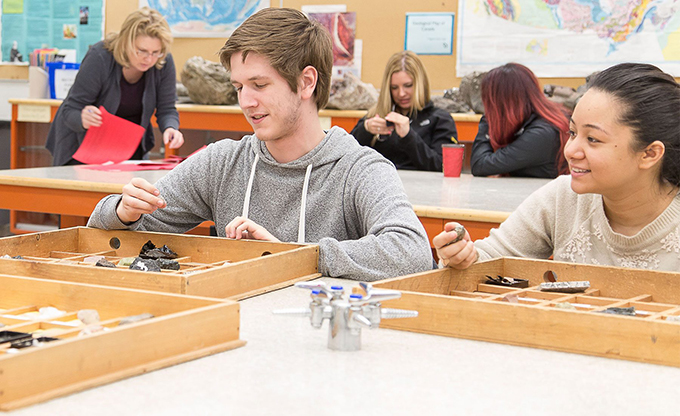
 Earth science is vital to Australia’s economic and environmental future but we are dramatically decreasing our earth science capability. Earth scientists work not only in mining and mineral exploration (which contribute 11% of Australia’s GDP) but also in fields such as environmental science, groundwater monitoring for the agricultural and environmental sectors, geotechnical work for the construction industry, and satellite remote sensing. These skills will be increasingly important to meet the challenges of climate change, particularly as renewable energy sources require new discoveries of minerals for batteries, electric cars and wind turbines.
Already in short supply, geologists, geophysicists and earth science technicians are on the skilled occupation list for immigration. Despite this need, Australian universities have recently made huge cuts to earth science teaching. In the past year, the University of Newcastle and Macquarie University have closed entire earth science departments.
Earth science is vital to Australia’s economic and environmental future but we are dramatically decreasing our earth science capability. Earth scientists work not only in mining and mineral exploration (which contribute 11% of Australia’s GDP) but also in fields such as environmental science, groundwater monitoring for the agricultural and environmental sectors, geotechnical work for the construction industry, and satellite remote sensing. These skills will be increasingly important to meet the challenges of climate change, particularly as renewable energy sources require new discoveries of minerals for batteries, electric cars and wind turbines.
Already in short supply, geologists, geophysicists and earth science technicians are on the skilled occupation list for immigration. Despite this need, Australian universities have recently made huge cuts to earth science teaching. In the past year, the University of Newcastle and Macquarie University have closed entire earth science departments.
Earth science jobs have also been lost at other universities including ANU, UNSW, Tasmania and Melbourne. Almost every university in the eastern states has cut undergraduate courses in earth sciences.
Federal government policies bear significant responsibility for this loss of earth science capability. The lack of JobKeeper support for universities during the pandemic has been widely discussed, but the unhelpful policies run much deeper.
Earth science is vital to Australia’s economic and environmental future but we are dramatically decreasing our earth science capability. Earth scientists work not only in mining and mineral exploration (which contribute 11% of Australia’s GDP) but also in fields such as environmental science, groundwater monitoring for the agricultural and environmental sectors, geotechnical work for the construction industry, and satellite remote sensing. These skills will be increasingly important to meet the challenges of climate change, particularly as renewable energy sources require new discoveries of minerals for batteries, electric cars and wind turbines.
Already in short supply, geologists, geophysicists and earth science technicians are on the skilled occupation list for immigration. Despite this need, Australian universities have recently made huge cuts to earth science teaching. In the past year, the University of Newcastle and Macquarie University have closed entire earth science departments.
Earth science is vital to Australia’s economic and environmental future but we are dramatically decreasing our earth science capability. Earth scientists work not only in mining and mineral exploration (which contribute 11% of Australia’s GDP) but also in fields such as environmental science, groundwater monitoring for the agricultural and environmental sectors, geotechnical work for the construction industry, and satellite remote sensing. These skills will be increasingly important to meet the challenges of climate change, particularly as renewable energy sources require new discoveries of minerals for batteries, electric cars and wind turbines.
Already in short supply, geologists, geophysicists and earth science technicians are on the skilled occupation list for immigration. Despite this need, Australian universities have recently made huge cuts to earth science teaching. In the past year, the University of Newcastle and Macquarie University have closed entire earth science departments.
Earth science jobs have also been lost at other universities including ANU, UNSW, Tasmania and Melbourne. Almost every university in the eastern states has cut undergraduate courses in earth sciences.
Federal government policies bear significant responsibility for this loss of earth science capability. The lack of JobKeeper support for universities during the pandemic has been widely discussed, but the unhelpful policies run much deeper.
Universities dealt dud hand in JobKeeper funding lottery: Garnaut ….and Geosciences in particular… https://t.co/2Fp2g4Npeh
— Bruce Schaefer (@brucefschaefer) March 25, 2021
Funding changes hit earth science teaching hard
Despite its importance, earth science undergraduate enrolments in Australia are modest. Most years only about 200 students graduate with an honours degree (the minimum generally required to be employed in the field), while over 15,000 people work as geoscientists in Australia. Commonwealth funding for university teaching is based on student numbers, so earth science departments receive little teaching income. The stated aim of the 2020 Job-Ready Graduates Package was to address this by “better preparing students for jobs that reflect Australia’s expected economic, industry and employment growth”. The package did reduce fees for earth science students. However, it did not increase funding to cover the resulting fee shortfall. As a result, university income was reduced by 16% for science students and 29% for environmental science students. At a time when universities are deciding which courses to cut, these suddenly less profitable courses have risen to the top of the list.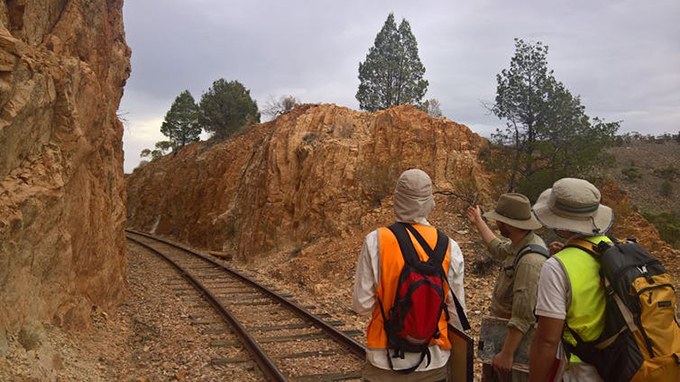
People with earth science skills are listed as a priority for immigration, but Australia is decreasing its own supply of graduates with these skills. Photo: Adam Bailey, University of Adelaide second-year geology mapping camp in the Ikara-Flinders Ranges, Author provided (no reuse)
