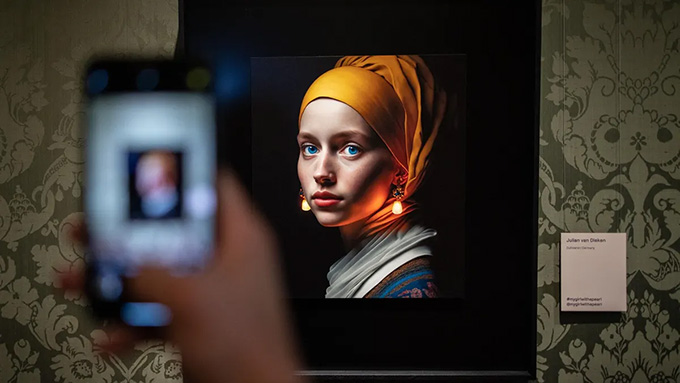
 Generative AI tools such as Midjourney, Stable Diffusion and DALL-E 2 have astounded us with their ability to produce remarkable images in a matter of seconds.
Despite their achievements, however, there remains a puzzling disparity between what AI image generators can produce and what we can. For instance, these tools often won’t deliver satisfactory results for seemingly simple tasks such as counting objects and producing accurate text.
If generative AI has reached such unprecedented heights in creative expression, why does it struggle with tasks even a primary school student could complete?
Exploring the underlying reasons helps sheds light on the complex numerical nature of AI, and the nuance of its capabilities.
Generative AI tools such as Midjourney, Stable Diffusion and DALL-E 2 have astounded us with their ability to produce remarkable images in a matter of seconds.
Despite their achievements, however, there remains a puzzling disparity between what AI image generators can produce and what we can. For instance, these tools often won’t deliver satisfactory results for seemingly simple tasks such as counting objects and producing accurate text.
If generative AI has reached such unprecedented heights in creative expression, why does it struggle with tasks even a primary school student could complete?
Exploring the underlying reasons helps sheds light on the complex numerical nature of AI, and the nuance of its capabilities.
AI’s limitations with writing
Humans can easily recognise text symbols (such as letters, numbers and characters) written in various different fonts and handwriting. We can also produce text in different contexts, and understand how context can change meaning. Current AI image generators lack this inherent understanding. They have no true comprehension of what any text symbols mean. These generators are built on artificial neural networks trained on massive amounts of image data, from which they “learn” associations and make predictions. Combinations of shapes in the training images are associated with various entities. For example, two inward-facing lines that meet might represent the tip of a pencil, or the roof of a house. But when it comes to text and quantities, the associations must be incredibly accurate, since even minor imperfections are noticeable. Our brains can overlook slight deviations in a pencil’s tip, or a roof – but not as much when it comes to how a word is written, or the number of fingers on a hand. As far as text-to-image models are concerned, text symbols are just combinations of lines and shapes. Since text comes in so many different styles – and since letters and numbers are used in seemingly endless arrangements – the model often won’t learn how to effectively reproduce text. The main reason for this is insufficient training data. AI image generators require much more training data to accurately represent text and quantities than they do for other tasks.The tragedy of AI hands
Issues also arise when dealing with smaller objects that require intricate details, such as hands.
Two AI-generated images produced in response to the prompt ‘young girl holding up ten fingers, realistic’. Shutterstock AI
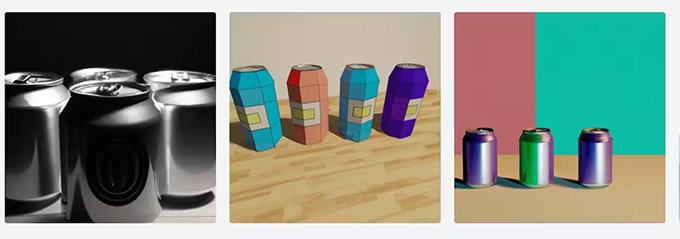
Three AI-generated images produced in response to the prompt ‘5 soda cans on a table’. Shutterstock AI
